Do Superstar Firms Face Lower Tax Burdens?
SSRN (opens in a new tab)Abstract: Do Superstar Firms Face Lower Tax Burdens?
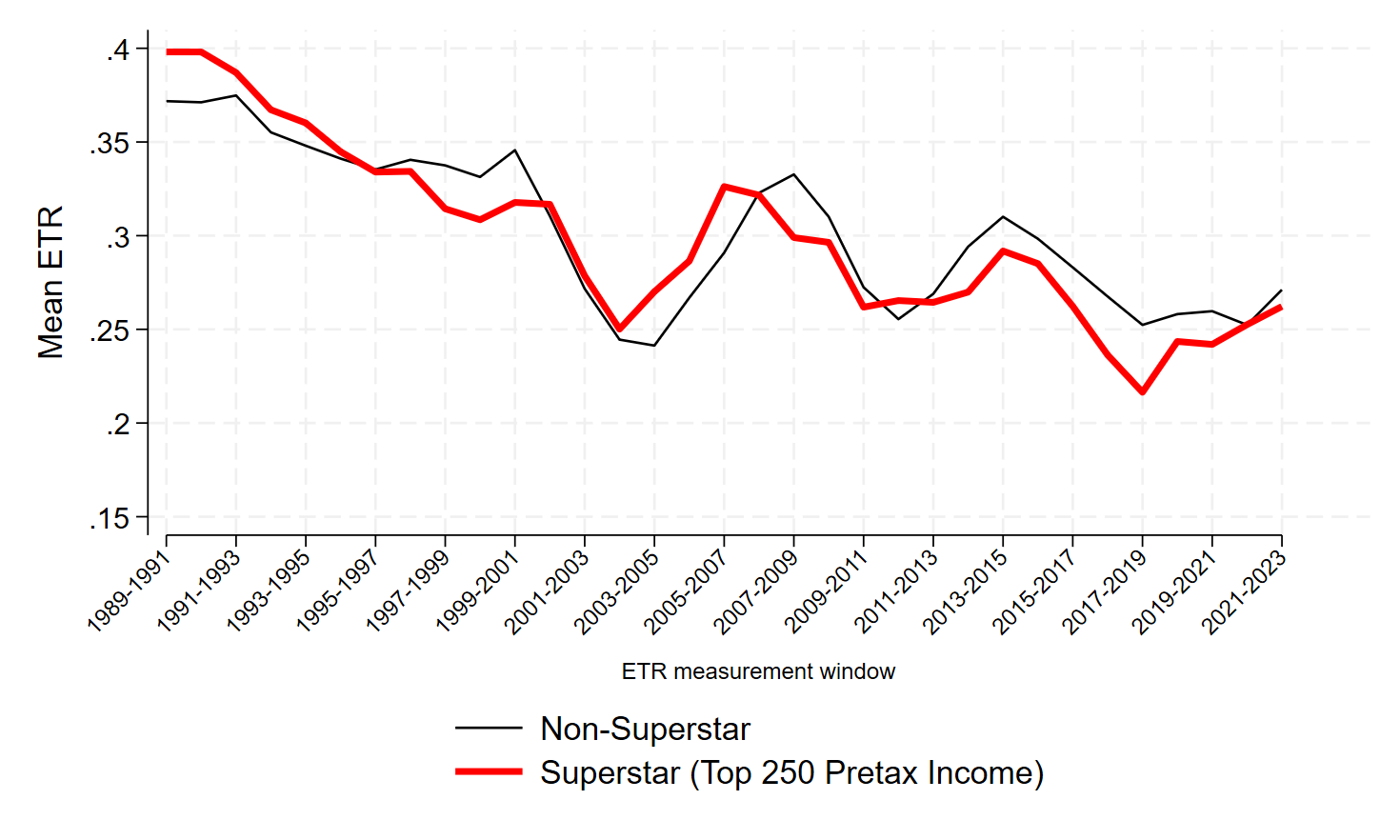
Policymakers have recently enacted corporate tax increases that apply only to the largest and most profitable firms, including the U.S. Corporate Alternative Minimum Tax and the OECD’s Pillar 1 and 2 regimes. These policies are motivated, at least in part, by the view that the largest and most profitable firms – commonly described as “superstar firms” in the academic literature – face lower tax burdens than other firms. We examine this premise, classifying superstar firms primarily using the income and revenue thresholds embedded in current tax policies. Using traditional cash effective tax rates, we find little evidence that superstar firms face systematically lower future tax burdens than other public firms. The evidence changes markedly when we adjust the denominator for internally generated intangibles. Under this intangible-adjusted effective tax rate, superstar firms generally face higher, not lower, future tax burdens. These findings are robust to alternative pretax-income and revenue thresholds. The important exception is the “Magnificent Seven,” which exhibit substantially lower future tax burdens under both measures in recent years. Overall, our evidence suggests that recent superstar-oriented tax policies cast a wider net than the set of firms that appear to enjoy systemically lower tax burdens.