Research

Taxes and investment, household finance, retirement savings, corporate tax, and market power.

Publications

Do Superstar Firms Face Lower Tax Burdens?

SSRN (opens in a new tab)

With John Gallemore and Ed Maydew

Accepted at Review of Accounting Studies

Abstract: Do Superstar Firms Face Lower Tax Burdens?

Policymakers have recently enacted corporate tax increases that apply only to the largest and most profitable firms, including the U.S. Corporate Alternative Minimum Tax and the OECD’s Pillar 1 and 2 regimes. These policies are motivated, at least in part, by the view that the largest and most profitable firms – commonly described as “superstar firms” in the academic literature – face lower tax burdens than other firms. We examine this premise, classifying superstar firms primarily using the income and revenue thresholds embedded in current tax policies. Using traditional cash effective tax rates, we find little evidence that superstar firms face systematically lower future tax burdens than other public firms. The evidence changes markedly when we adjust the denominator for internally generated intangibles. Under this intangible-adjusted effective tax rate, superstar firms generally face higher, not lower, future tax burdens. These findings are robust to alternative pretax-income and revenue thresholds. The important exception is the “Magnificent Seven,” which exhibit substantially lower future tax burdens under both measures in recent years. Overall, our evidence suggests that recent superstar-oriented tax policies cast a wider net than the set of firms that appear to enjoy systemically lower tax burdens.
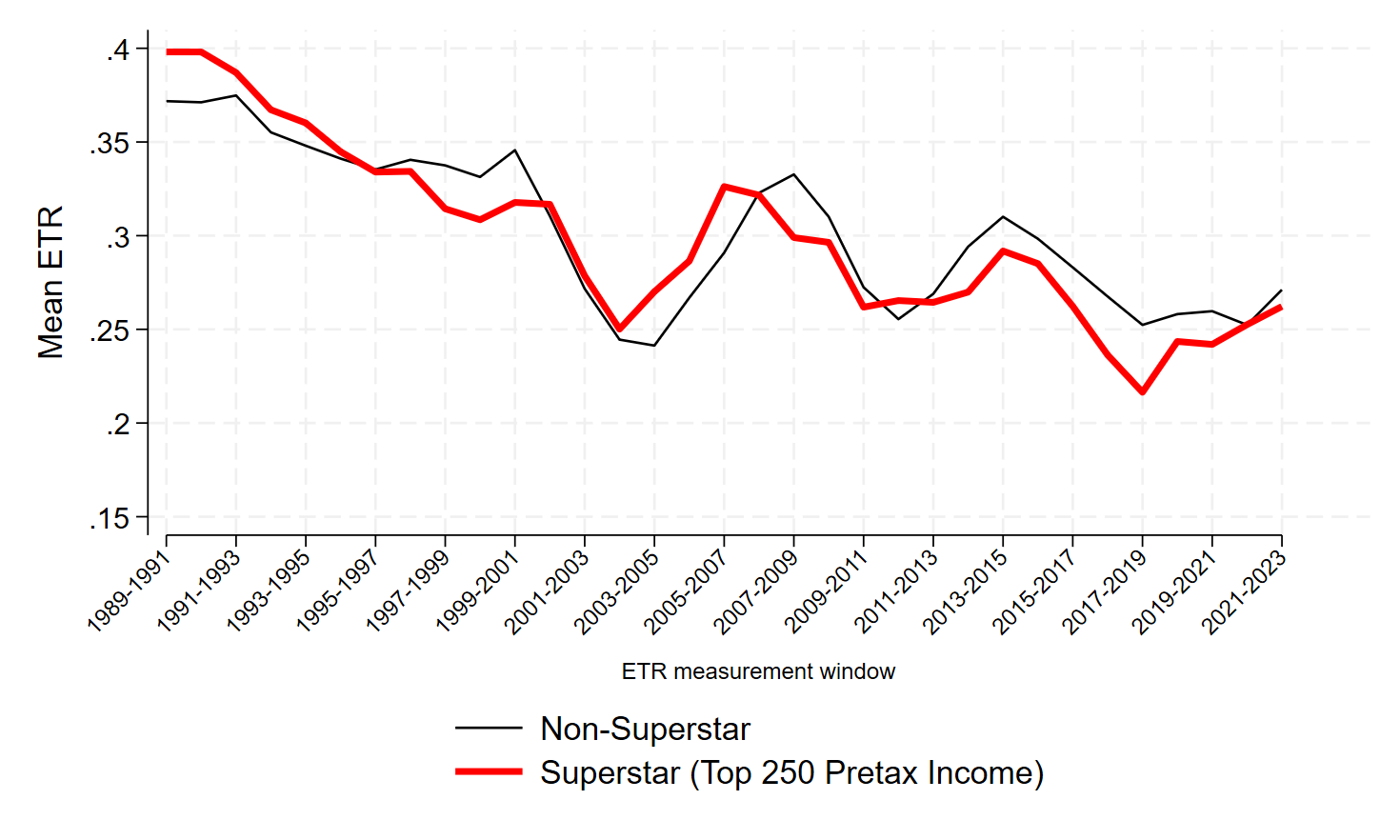
Mean effective tax rates for superstar and non-superstar firms across ETR measurement windows.
View full-size figure for Do Superstar Firms Face Lower Tax Burdens? (opens in a new tab)

Working Papers

Protectionism and Home Bias

Solo-authored

Abstract: Protectionism and Home Bias

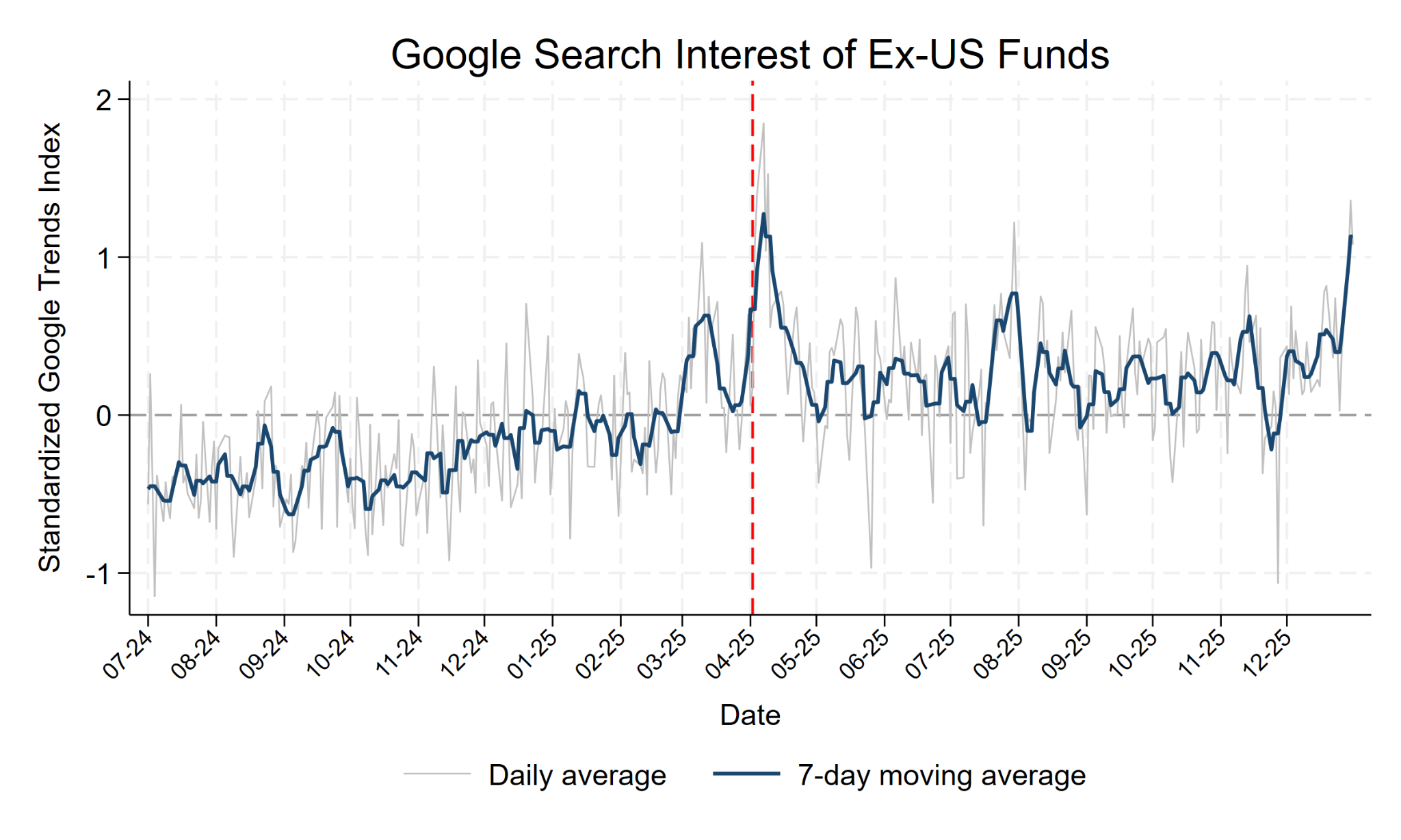
This paper examines whether protectionism decreases home bias among U.S. investors. Using the April 2, 2025, “Liberation Day” tariffs as a setting, I document outflows from U.S. mutual funds relative to international funds. U.S. investors reallocate assets across international markets in a manner not explained by the tariff rates. Flows shift toward funds with exposure to countries with stronger rule of law. Retail investors become more responsive to funds with greater IFRS exposure and become less averse to country risk premia while institutions do not. Moreover, retail investor flows suggest that U.S. stocks may become less effective as a hedge against non-tradable labor income risk. Overall, protectionist policy may reduce investment in domestic assets, producing the opposite investment effect from that intended.

Presentations: 2026 Texas-Waterloo Taxation Research Symposium

Google search interest in ex-US funds over time, showing daily values and a seven-day moving average.
View full-size figure for Protectionism and Home Bias (opens in a new tab)

Do Taxes or Age Explain Retail Dividend Clienteles?

SSRN (opens in a new tab)

Solo-authored

Abstract: Do Taxes or Age Explain Retail Dividend Clienteles?

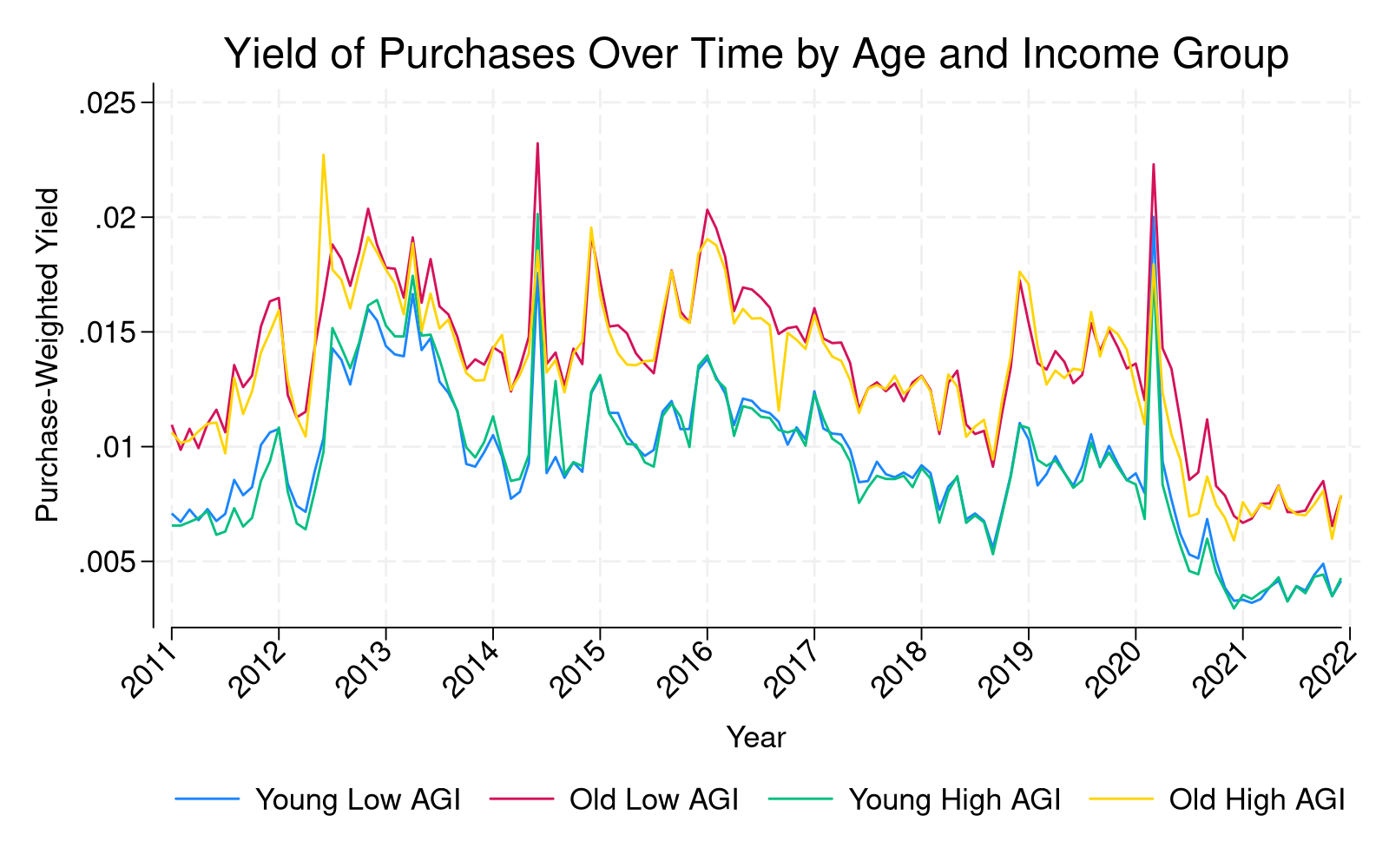
This paper examines the relative importance of age and tax effects in explaining dividend clienteles among retail investors. Prior work draws inferences from limited datasets that confound age and tax status, typically focusing on older low-tax and younger high-tax investors. To address these shortcomings, I use comprehensive administrative data covering all taxable U.S. stock trades by 105 million individuals from 1999 to 2022, allowing a joint test of age and tax effects in the modern retail trading environment. Results suggest substantial age-related heterogeneity in dividend preferences, particularly among high-income investors. Tax incentives also affect dividend-related trading, but age-related differences remain pronounced even when tax incentives favor dividend avoidance.

Presentations: 2026 FARS Midyear Meeting; 2026 ATA Midyear Meeting; 2026 North Carolina State University

Purchase-weighted dividend yields from 2011 to 2022 by age and income group.
View full-size figure for Do Taxes or Age Explain Retail Dividend Clienteles? (opens in a new tab)

Age Heterogeneity in Trading Activity

With Cami Kuhnen and Lu Yang

Abstract: Age Heterogeneity in Trading Activity

Using novel data on retail trades, this paper challenges prior claims that investment performance declines with age. Younger investors trade a narrower set of securities than older investors and show greater interest in high-volatility securities like leveraged and inverse ETFs. Differences in stock selection lead to age-based heterogeneity in performance. Although younger investors achieve higher returns in most periods, they exhibit greater volatility in 95 percent of monthly comparisons. Older investors achieve similar returns with less volatility and significantly higher Sharpe ratios in most monthly comparisons. These findings qualify prior evidence of better performance by younger investors in earlier datasets.

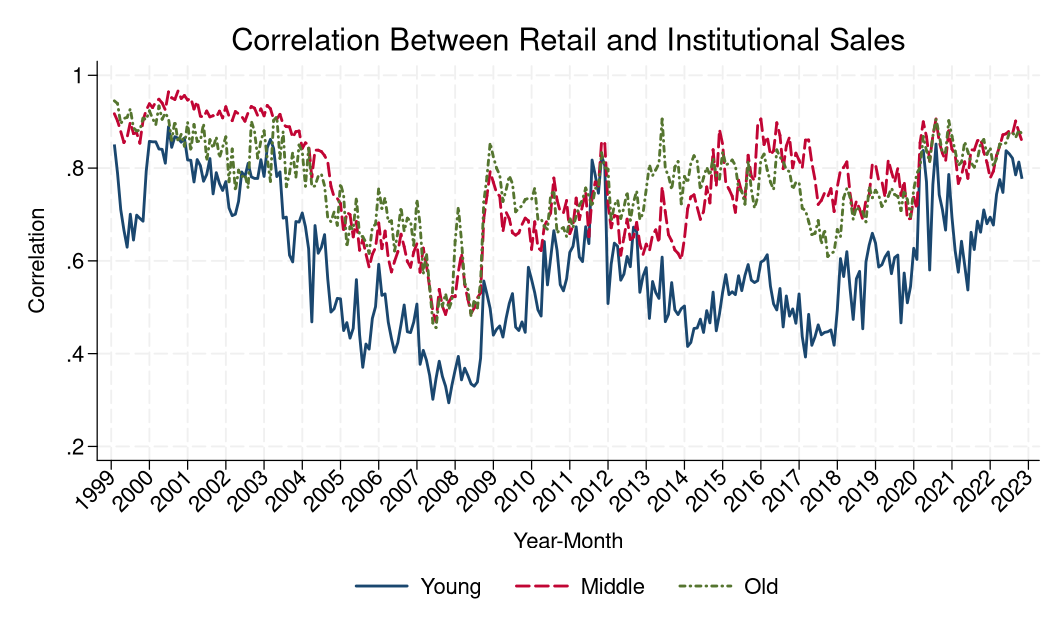
Correlation between retail and institutional sales over time for young, middle-aged, and older investors.
View full-size figure for Age Heterogeneity in Trading Activity (opens in a new tab)

Selected Research in Process

¿Impuestos?

With Jeff Hoopes and John Gallemore

Other Writing